Pelletier awarded at Colloquy
Kevin Pelletier, associate professor of English, received the 2026 Distinguished Educator Award from the University of Richmond at Colloquy.
Brooke Jarvis ’07 was featured in the New York Times.
Matt Mattox ’02 was featured in Richmond Times Dispatch for Martin Agency.
Lucy Nalen, ’19, had her literary magazine "And So Yeah" profiled in The Collegian.
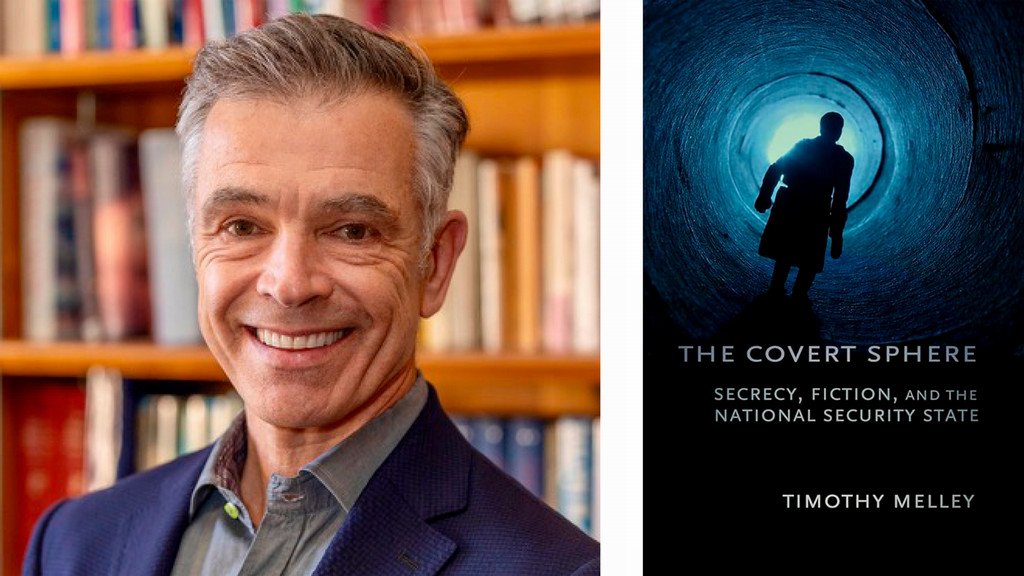
Brown-Alley Room, Weinstein Hall
How did conspiracy theory move from the margins of American political life to the Oval Office? This talk traces the rise of conspiracy theory as a Cold War-era social concept and explains why it has become such a salient and disturbing feature of contemporary culture. Conspiracy theory is often understood as an easily-identified problem of logic that can be corrected by a redoubling of Enlightenment rationality — more fact-checking, more debunking, more transparency. But conspiratorial suspicion is also a reflection of important structural changes in the democratic public sphere. It cannot be fully explained by a psychology of individual personality or the analysis of individual cognition — as revealing as these approaches sometimes are. We also need an approach that distinguishes valuable forms of institutional scrutiny from misinformation and political melodrama, and this understanding, I argue, must take account of central role of conspiracy narratives in American cinema, television, and fiction.
Timothy Melley is professor of English and director of the Humanities Center at Miami University. He is the author of The Covert Sphere: Secrecy, Fiction, and the National Security State (Cornell 2012), Empire of Conspiracy: The Culture of Paranoia in Postwar America (Cornell 2000), and numerous essays and stories. His new book, Imagining National Security: Fiction and the Ends of Democracy is forthcoming from the University of Minnesota Press.

The University of Richmond’s Writers Series exposes Richmond students, the greater university community, and city residents to some of today’s most celebrated writers. Readings are free and open to the public, though seating is on a first-come, first-served basis. Each reading will be followed by a Q&A session and book signing.
The Writers Series is sponsored by the Department of English and the School of Arts & Sciences.

The Nature of Representation asks how our understandings of “nature” have been shaped by representational practices in both the aesthetic and political senses, exploring how the current climate catastrophe is inextricable from colonialism and anthropocentric worldviews. The festival features contemporary writers, artists, and thinkers who don’t take for granted that language is merely human, that there are other “natural” languages, and that attuning to those other languages allows us to tell stories that disrupt the violence of Man.
Kevin Pelletier, associate professor of English, received the 2026 Distinguished Educator Award from the University of Richmond at Colloquy.
Nathan Snaza was promoted to associate professor of English. His work explores how ideas about what it means to be human have been put to work in educational institutions, especially those that engage language, literacy, and literature. He draws on work in the fields of affect theory, new materialisms, queer and feminist theory, and Black and decolonial studies.

Brian Henry, professor of English and creative writing, was named to the shortlist for the 2025 Griffin Poetry Prize, the world's largest prize for a book of poetry. He was selected for his translated and edited edition of Tomaž Šalamun's Kiss of the Eyes of Peace, Selected Poems 1964-2014.

Julietta Singh, professor of English and women, gender, & sexuality studies, directed The Nest, a feature-length documentary, which will make its world premiere at the upcoming Hot Docs Festival in Toronto, Canada.


Transformational gift will support the priorities of the Accelerate Richmond campaign, including a $50M matching fund for endowed scholarships.


American studies professor Stephen Brauer, who is working on a book about sports writing, is quoted.

Julietta Singh, professor of English and gender and sexuality studies, is interviewed about her film The Nest.

A film by Julietta Singh, professor of English and women, gender, and sexuality studies, is featured.

English professor Stephen Brauer authored this piece, originally published in The Conversation.

UR Summer Fellowships: Masnoon Majeed and Dr. David Stevens
University of Richmond students discuss summer research opportunities that give them a chance to explore their passions through hands-on projects, all while making a difference in the wider world

UR Summer Fellowships: Katie Skipper and Libby Gruner
University of Richmond students discuss summer research opportunities that give them a chance to explore their passions through hands-on projects, all while making a difference in the wider world.

Writers Series: Robert Olen Butler
2014
Mailing address:
English Department, Humanities Building 318
106 UR Drive
University of Richmond, VA 23173
Phone: (804) 289-8287
Fax: (804) 289-8313
Department Chair: Dr. David Stevens
Academic Administrative Coordinator: Emily Tarchokov